
From product data to verification-ready PCF reports.
NxMap Product helps companies calculate, manage, and report Product Carbon Footprints (PCFs) aligned with ISO 14067. The platform is built for manufacturers, sustainability teams, and supply chain teams responding to customer disclosure, supplier engagement, tender, CBAM-related, and third-party verification needs. NxMap Product replaces spreadsheet-heavy PCF studies with structured data collection, lifecycle inventory dataset access, hotspot analysis, report generation, and verification support.
NxMap Product is Evercomm’s dedicated Product Carbon Footprint platform for companies that need reliable, auditable PCF results without depending on complex manual spreadsheets or specialist Life Cycle Assessment (LCA) software.
The platform helps teams apply ISO 14067, ISO 14040, and ISO 14044 requirements in a structured digital environment, with lifecycle inventory dataset access, calculation traceability, hotspot analysis, report generation, and verification support built into the workflow.
For leadership, NxMap Product provides product-level carbon visibility for customer requests, export requirements, supplier engagement, and decarbonisation planning.
For sustainability and technical teams, it provides structured data entry, calculation traceability, lifecycle inventory dataset references, data quality checks, audit trails, and verification-ready report outputs.

Respond to customer PCF requests
Disclose product-level emissions
Move beyond spreadsheet-based PCF workbooks
Assess supplier and material impacts
Deliver ISO 14067-aligned studies at scale
Review calculation records, assumptions, and disclosures
NxMap Product supports the global and APAC reporting standards that customers and regulators require. Its flexible data foundation lets teams use the same product data and calculation engine across the reporting requirements relevant to their business.
Generates ISO 14067-aligned PCF reports with study details, calculation records, data quality checks, sensitivity and uncertainty analysis, audit trails, and verification disclosures. The reporting output supports customer, supplier, tender, CBAM-related, and third-party verification needs.
Licensed access to ecoinvent lifecycle inventory data for product studies, supporting stronger dataset selection, impact calculation, and ISO 14067-aligned reporting. This gives users access to high-quality lifecycle inventory data inside the PCF study workflow, reducing the need to manage external datasets manually.
Provides a structured workflow for PCF study setup, data collection, review, and report preparation. NxMap Product makes the required PCF process easier to execute, review, and document.
Supports built-in databases, custom emission factors, and Excel activity data upload to reduce manual entry and improve consistency across product studies. Teams can upload product activity data and apply suitable emission factors without rebuilding calculation workbooks from scratch.
Outbound · Insight
Results can be analysed by lifecycle stage, activity type, and process flow, including Sankey diagram visualisation. This helps teams identify which materials, suppliers, processes, transport activities, or lifecycle stages drive the product footprint.
Create, track and manage your lifecycle studies
Create and manage product footprint studies in one workspace. NxMap Product brings together product data, lifecycle inventory data, calculations, review steps, and reporting so teams can produce traceable PCF results with confidence.
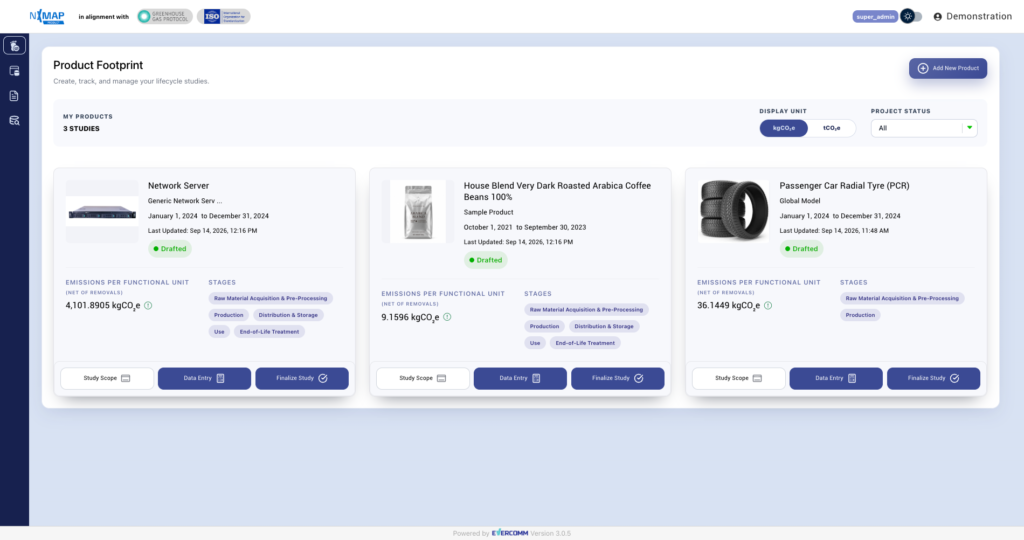
Review Product information, emission summary and breakdowns
Capture activity data by lifecycle stage and connect each input to the appropriate emission factor. Teams can review values, units, sources, and calculated emissions in the same workflow.

Full Data overview in a single page
Generate and manage reports across all products from one library. Each finalised study exports as an ISO 14067 report in Word and a GHG inventory report in Excel, ready for a customer, a tender submission, or a third-party reviewer.

NxMap Product is designed to support Product Carbon Footprint studies aligned with ISO 14067, with methodology support for ISO 14040 and ISO 14044 Life Cycle Assessment principles. The platform supports third-party verification by maintaining study boundaries, documented assumptions, data quality checks, lifecycle inventory dataset references, calculation records, final report disclosures, and traceable audit records. Security and governance features include role-based access control, encrypted platform access, unique study records, and audit trails linking inputs, calculations, and outputs.

NxMap Product is designed to support Product Carbon Footprint studies aligned with ISO 14067, with methodology support for ISO 14040 and ISO 14044 Life Cycle Assessment principles.
The platform supports third-party verification by maintaining study boundaries, documented assumptions, data quality checks, lifecycle inventory dataset references, calculation records, final report disclosures, and traceable audit records.
Security and governance features include role-based access control, encrypted platform access, unique study records, and audit trails linking inputs, calculations, and outputs.

Bureau Veritas-validated software functionality for ISO 14067 Product Carbon Footprint calculation. CF Platform Certificate from Thailand Greenhouse Gas Management Organization (TGO)
Banking, industrial, and public sector all sit on the same Nx-Engine foundation. The use cases differ; the data discipline is identical.
The engines that power AI with facts.
The Nx-Engine + NxOps / NxMap / NxPlan stack. Many Assurance customers graduate to deploying Granular Data themselves — typically 12–18 months after their first engagement, once internal capability is built. Same engines, just operated in-house.
Assess. Simulate. Verify.
Independent assessment, simulation, and verification. Assurance engagements often surface the transitions that need capital next — making Aligned Products and Aligned Ventures the natural follow-on conversation.
Learn More About PCF Studies →
